WELCOME TO THE GTCIO | A DIVISION OF OGEECHEE TECHNICAL COLLEGE

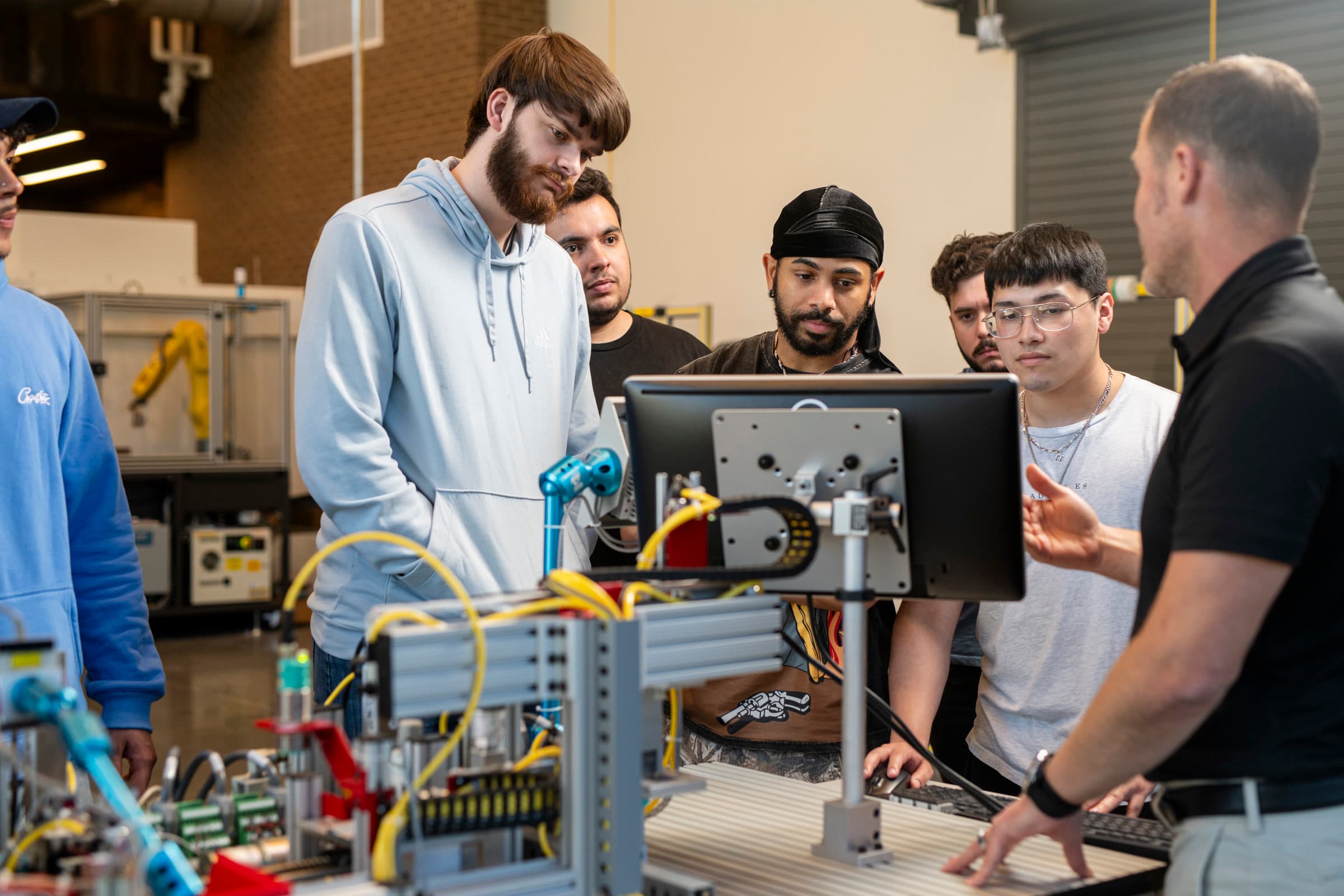
Students gathered around automation equipment as an instructor explains it

IOT Diploma Program

Courses & credit hours

The full Industrial Operations Technology diploma: 12 program courses plus 3 general education courses, 53 credit hours total, and an industry credential attached to nearly every program course.

The program at a glance

15

Courses

53

Credit hours

IS32

Program code

Industrial Operations Technology diploma program courses, credit hours, and SACA credentials
CourseTitleCreditsCredentials
ISAT 1102Electrical Systems4SACA C-201, SACA C-206
ISAT 1105Motor Control Systems and Troubleshooting4SACA C-202, SACA C-204
ISAT 1103Programmable Logic Control I4SACA C-207, SACA C-212
ISAT 1104Programmable Logic Control II4SACA C-208
ISAT 1130Sensors in Industrial Smart Automation4SACA C-205, SACA C-203, SACA C-213
ISAT 1110Mechanical Systems4SACA C-210, SACA C-301
ISAT 1120Hydraulic & Pneumatic Systems4SACA C-209, SACA C-255, SACA C-304
ISAT 2010Industrial Robotics I3SACA C-215, SACA C-103
ISAT 2020Industrial Robotics II3SACA C-216, FANUC-1
CIST 1601Information Security Fundamentals3
ISAT 2030Operations Technology I4SACA C-101, SACA C-104, OSHA 10
ISAT 2040Operations Technology II4SACA C-102
Program course totals45

Credential codes beginning with C- are issued by the Smart Automation Certification Alliance (SACA). See what each one covers.

Required general education courses

Required general education courses for the Industrial Operations Technology diploma
CourseTitleCredits
ENGL 1010Fundamentals of English I3
MATH 1111College Algebra3
EMPL 1000Interpersonal Relations and Professional Development2
General education totals8
Total credits53

Course by course

ISAT 1102 · 4 credit hours

Electrical Systems

What you'll learn to do

  • Apply electrical system safety
  • Connect and operate basic electrical circuits
  • Interpret electrical schematics and diagrams
  • Use a digital multimeter (DMM) to make electrical measurements
  • Analyze basic load circuits
  • Test and replace/reset fuses and circuit breakers
  • Connect and operate basic reactive components
  • Analyze basic combination circuits
  • Troubleshoot basic series and parallel electrical circuits
  • Analyze inductive circuits
  • Analyze capacitive circuits

Credentials earned

ISAT 1105 · 4 credit hours

Motor Control Systems and Troubleshooting

What you'll learn to do

  • Apply motor control safety procedures
  • Connect and operate motor control circuits using 3-phase AC motors
  • Connect and operate magnetic motor starters, control relays, and timer relays
  • Interpret motor control ladder logic diagrams
  • Check motor control circuits for proper ground connections
  • Wire motors for high and low voltage
  • Interpret motor control application circuits
  • Apply troubleshooting safety procedures
  • Troubleshoot faults in electric motor control circuits and AC variable frequency drives
  • Test motor control components
  • Use a digital multimeter, clamp-on ammeter, and PLC status indicators to troubleshoot motor control circuits

Credentials earned

ISAT 1103 · 4 credit hours

Programmable Logic Control I

What you'll learn to do

  • Start up and shut down a PLC system
  • Configure an Ethernet/IP driver
  • Transfer programs between a PLC and PC via point-to-point Ethernet
  • Transfer programs between a PLC and PC via USB serial
  • Operate and monitor a PLC
  • Connect, configure, and operate an HMI panel with Ethernet
  • Configure PLC discrete I/O
  • Program and operate a basic PLC logic program
  • Create a PLC project
  • Program and operate a PLC logic program that uses comparison instructions
  • Program and operate a PLC project that uses math instructions
  • Program and operate a PLC motor control sequence program
  • Program and operate a basic PLC sequence program

Credentials earned

ISAT 1104 · 4 credit hours

Programmable Logic Control II

What you'll learn to do

  • Use status and diagnostic indicators to troubleshoot a PLC
  • Troubleshoot PLC inputs and outputs
  • Troubleshoot a PLC power distribution system
  • Troubleshoot a PLC processor
  • Troubleshoot a PLC system with discrete I/O
  • Program and operate a multi-step PLC sequence program
  • Troubleshoot a multi-step PLC sequence program

Credentials earned

ISAT 1130 · 4 credit hours

Sensors in Industrial Smart Automation

What you'll learn to do

  • Identify and select an electronic sensor for an application
  • Connect and test an inductive proximity sensor
  • Connect and test a capacitive proximity sensor
  • Connect and test a magnetic reed switch
  • Connect and test a hall-effect sensor
  • Connect and test a photoelectric sensor
  • Interpret basic electrical control schematics
  • Connect and test electro-pneumatic power circuits
  • Connect and test electric relay sequence control circuits
  • Connect and test a relay sequence circuit that uses electronic sensors

Credentials earned

ISAT 1110 · 4 credit hours

Mechanical Systems

What you'll learn to do

  • Identify mechanical power transmission type and application
  • Apply mechanical power transmission safety procedures
  • Use a dial indicator to measure component dimensions
  • Install and mount a motor
  • Select and install a shaft key and hub
  • Install and adjust pillow block and flange bearings
  • Install and align a shaft system with a flexible jaw coupling
  • Install and adjust a basic V-belt drive system
  • Install and adjust a basic chain drive system
  • Install and align a gear drive system
  • Monitor the performance of a mechanical power transmission system
  • Apply lubrication to mechanical components

Credentials earned

ISAT 1120 · 4 credit hours

Hydraulic & Pneumatic Systems

What you'll learn to do

  • Apply pneumatic system safety procedures
  • Connect and adjust a pneumatic supply line
  • Start up and shut down a reciprocating air compressor
  • Interpret pneumatic schematics
  • Connect and operate basic pneumatic circuits
  • Connect and adjust flow control and needle valves
  • Monitor performance of pneumatic system pressure and force
  • Monitor pneumatic system operation
  • Perform basic pneumatic system servicing

Credentials earned

ISAT 2010 · 3 credit hours

Industrial Robotics I

What you'll learn to do

  • Identify robot type and applications
  • Identify the components of an articulated servo robot
  • Identify types of end-of-arm tooling
  • Determine robot work envelope
  • Identify robot workcell safety features
  • Perform a robot workcell safety inspection
  • Apply robot safety procedures
  • Power up and shut down a robot
  • Use a teach pendant to view menus and status indicators
  • Identify robot model number and version data
  • Jog an articulated robot in joint mode
  • Set and test robot joint travel limits
  • Identify robot position in each of 5 frames
  • Jog an articulated robot using Cartesian coordinates
  • Define a tool frame and user frame
  • Load a robot program
  • Teach robot motion points and enter program commands
  • Test a robot program
  • Operate a robot in production
  • Recover a robot from basic faults

Credentials earned

ISAT 2020 · 3 credit hours

Industrial Robotics II

What you'll learn to do

  • Enter and interpret a robot program with motion commands
  • Enter and interpret robot program tool and user frame offset commands
  • Enter and interpret robot program data register commands
  • Enter and interpret robot program branching commands
  • Enter and interpret robot program looping and wait commands
  • Interface and test discrete robot inputs and outputs
  • Interface and test PLC I/O to a robot controller
  • Enter and interpret robot programs that use discrete I/O
  • Connect and test robot Ethernet network communications
  • Enter and test a robot program macro command
  • Develop and test a basic pick and place robot program
  • Develop and test a machine load/unload robot program
  • Develop and test a basic assembly robot program
  • Develop and test a basic gluing robot program

Credentials earned

CIST 1601 · 3 credit hours

Information Security Fundamentals

A broad overview of information security, covering terminology, history, and security systems development and implementation, along with the legal, ethical, and professional issues in the field.

ISAT 2030 · 4 credit hours

Operations Technology I

What you'll learn to do

  • Concepts and terminology of smart manufacturing
  • Basic setup, adjustment, and operation of automated machines
  • Safety and hand tools
  • Blueprint and schematic reading
  • Precision measurement
  • Basic electrical control, pneumatic, and sensor systems operation
  • Basic robot operation and terminology; production monitoring via HMI, internet, Ethernet, and smart phones
  • Smart manufacturing system metrics and optimization
  • Setup, adjustment, and operation of computer controlled machines
  • Basic Ethernet network operation
  • Basic programmable controller programming and operation
  • Basic mechanical and hydraulics system operation and adjustment
  • Basic mechatronic systems programming and operation
  • Basic robotics and CNC programming/operation
  • HMI interface and operation

Credentials earned

ISAT 2040 · 4 credit hours

Operations Technology II

What you'll learn to do

  • Concepts of the Industrial Internet of Things (IIoT)
  • PLC Ethernet messaging communications
  • Barcode and RFID programming and operation
  • Smart sensor programming and operation
  • Managed Ethernet switch configuration and operation
  • Variable frequency drive programming
  • SQL database systems
  • Data analytics and manufacturing execution systems (MES)
  • Lean manufacturing and system optimization

Credentials earned

ENGL 1010 · 3 credit hours

Fundamentals of English I

Required general education course. May instead be satisfied with ENGL 1101 – Composition & Rhetoric (also 3 credits).

MATH 1111 · 3 credit hours

College Algebra

Required general education course.

EMPL 1000 · 2 credit hours

Interpersonal Relations and Professional Development

Required general education course.

Ready to start?

Enrolling now. Applications go through Ogeechee Technical College.